

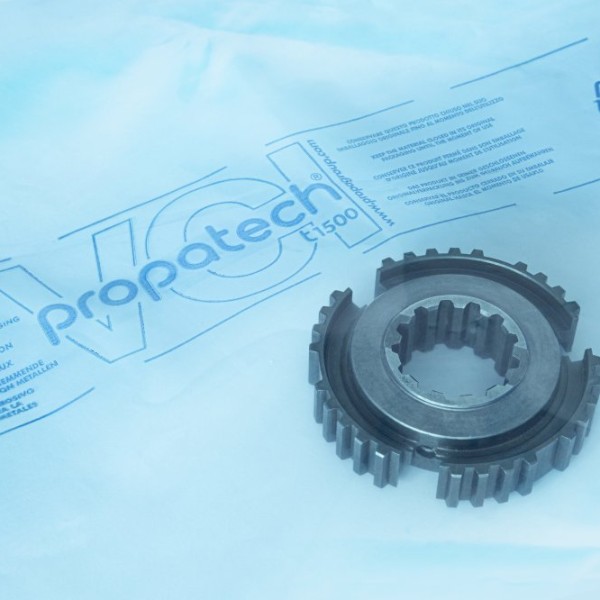
PROPATECH VCI Film T1500
High-strength transparent anti-corrosive coextruded film
Advanced technology for extreme protection: ultra-resistant films with thickness reduced up to 30% and maximum VCI effectiveness.
The PROPATECH VCI Film T1500 represents the latest technological frontier in anti-corrosive protection, developed in Propagroup research laboratories using highly technological resins and a customized coextrusion method. These innovative films offer superior performance in terms of mechanical resistance and low permeability to water vapor, while maintaining a reduced thickness up to 30% compared to traditional films. This unique characteristic allows for significant plastic material savings, reduction of disposal costs and lower environmental impact, without compromising protective effectiveness.
The 3-5 layer coextrusion technology of these films provides a unidirectionality of VCI molecules unique in the sector, creating a progressive and prolonged anti-corrosive protection and prolonged that perfectly adapts to the needs of the heavy and automotive industry. The T1500 films solve the problems of breakage during handling of heavy loads or sharp-edged ones, offer total protection even in severe environmental conditions and maintain complete transparency to facilitate product identification and customs procedures. Their high mechanical resistance combined with maximum VCI effectiveness makes them ideal for critical applications where long-lasting anti-corrosive protection is required with zero risks of packaging compromise.
The technology enclosed in the layers of PROPATECH VCI T1500 films has the following function:
- the inner layer guarantees immediate protection of the products to be protected;
- the intermediate layer acts as a reservoir of PROPATECH VCI molecules for long-term protection and at the same time guarantees their unidirectionality;
- the outer layer acts as a barrier against atmospheric agents and allows further containment of the protective action.
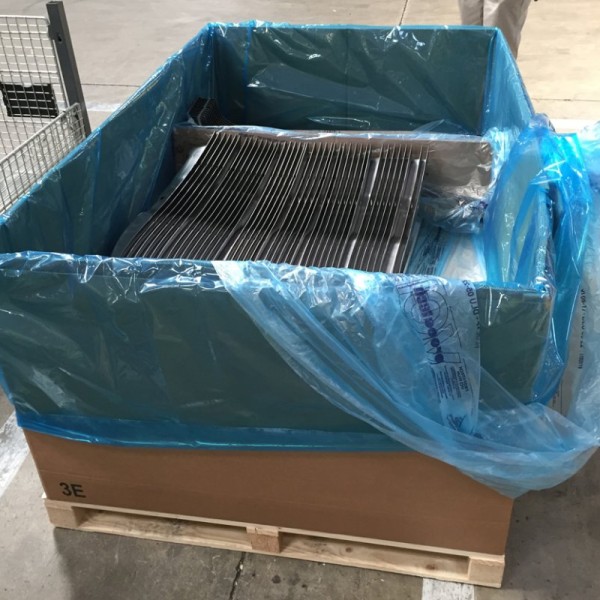
With PROPATECH VCI T1500 technology, films, bags, sacks and covers can be produced.
PROPATECH VCI T1500 films comply with TRGS 615 standard and are recyclable.
Problems solved by this product


Anticorrosion protection
To ensure proper protection of metal goods during the transportation phases, it is necessary for the packing to be made with suitable anticorrosion products. Propagroup is the leader in designing and developing antioxidant treatments able to effectively resolve the various problems of companies that transport and store metal goods, offering valid and safe anti-rust treatments in the Italian and international markets.
Antioxidant films, paper, and bags
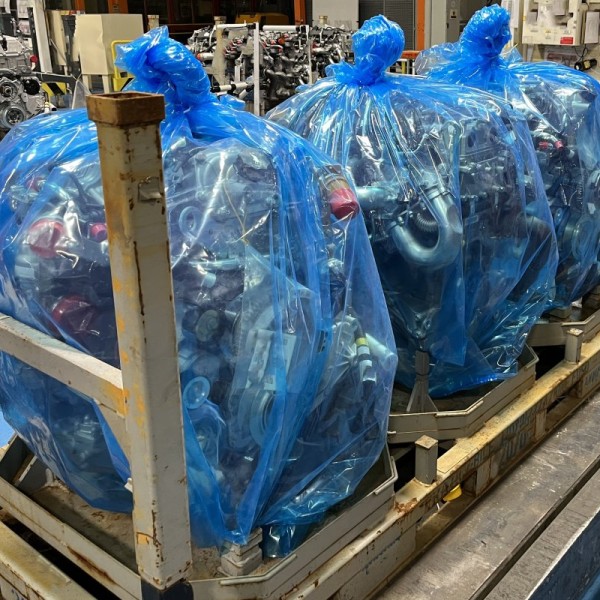
Propagroup has launched on the market VCI anticorrosion packing items to guarantee adequate protection of metals. The most-used products are: paper; shrink films; bags; and covers for protecting metal automotive components such as engine blocks, transmissions, gearboxes, and brake discs, as well as steel coils, entire machines, and metal products in general.
Completely recyclable items
Continuous investments in research and development combined with the expertise and professionalism acquired over more than 40 years in the market have allowed us to expand our market not only in Italy and Europe, but all over the world. The packing we offer is ideal for solving any problem regarding corrosion, humidity, or condensate, and also includes many anti-impact products. We operate in full respect of the environment, and we develop completely recyclable products that are entirely compliant with all environmental laws, regulations, and standards applicable to companies.
VCI stands for Volatile Corrosion Inhibitor.
VCI (Volatile Corrosion Inhibitor) can be used for all products that need a corrosion protection inside the packaging such as steel coils, automotive spare parts, engines, complete machineries and all kind of metal parts.
Products for VCI (Volatile Corrosion Inhibitor) protection are used, during shipments and storage, to preserve and protect metals against corrosion. Propagroup has figured out and developed products for VCI protection, helping companies to preserve goods quality for a long time. The anticorrosive VCI products guarantee quality perseverance of shipped and stored materials, no claims for oxidation, considerable saving and big customer satisfaction. Propagroup created Propatech VCI system that, thanks to the reduction or even elimination of use of oil and greases, guarantees that the product remains intact, clean and ready-to-use. Propatech VCI doesn't leave traces and it is not dangerous, this is very important for protection, preservation, safety and saving. Propagroup is leader to solve problems of corrosion, humidity and impacts of goods during transport. Propatech VCI product range for metal protection includes the following products:
Papers, double face and polythene anticorrosion products, in addition to rolls, sheets and bags;
Films, anticorrosion plastic materials like Propatech VCI film, Propaskin, Propasteel, Propastretch and Propabol;
Emitters and diffusers of VCI substances like Propatech VCI Noxy, foams, tablets and anticorrosive pill bags.
We recommend using desiccants inside your package, even in those made of VCI films, in order to improve corrosion protection.
Lab tests together with our over 40 years of experience confirm that the combination of VCI Propatech products with Propasec desiccant bags increases the effectiveness of both of them extending the protection of your goods.
The quantity of VCI to be used in order to effectively protect goods against corrosion depends on many factors, being the most relevant: shipping time, external conditions (e.g. by sea, by land), and type of product. We strongly recommend to contact us in order to determine the most efficient solution and design the most appropriate package.
There are different types of VCI depending on metal to protect.
Ferrous metals contain iron, for example steel, whilst non-ferrous metals do not contain iron, for example zinc, magnesium, and copper.
Some anticorrosive VCI products, like paper and certain films, work well in contact with the material to be protected, whereas VCI diffusers, for example, do work at a distance in order to saturate the inside of packaging with the VCI substance and protect the goods against corrosion attacks. VCI products are very often used together to protect metals both in contact and at a distance and to better preserve their quality over time.
VCI polyethylene has the big advantage of keeping VCI inside the packaging and of making a barrier, mainly isolating the product to protect. Furthermore polyethylene is very easy to use during packaging and the operations are much rapid, allowing an ease closing. As known, with the plastic packaging, in particular situations, is much easier that condensation occurs inside the packaging. This disadvantage can be easily solved with the use of desiccant products, perfect to reduce the humidity level, thus eliminating risks of damages caused by humidity.
The chemical or electrochemical reaction between a material, usually a metal, and its environment that produces a deterioration of the material and its properties.
Diffusion is the volatile distribution of VCI molecules into the packaging.
PROPATECH VCI products for the protection against corrosion are free from nitrites.
Nitrites are made of a nitrogen atom and two oxygen atoms negatively charged and it can be found in some anticorrosive VCI products on the market. Its presence has to be allowed and declared from the producer.
A corrosion reaction in which the corroded metal forms an oxide; usually applied to reaction with a gas containing elemental oxygen, such as air.
Transformation from a solid to a gaseous state of VCI molecules starting from the protective material (paper, film, diffusers, foams, etc...).
VCI is a Volatil Corrosion Inhibitor that can sublimate, from a solid to a gas state, and form a thin invisible layer able to neutralize corrosive agents such as: water vapour, oxygen, saline atmosphere, sulphurous gases and the most common industrial environmental pollutants present in the air.
The Volatile Corrosion Inhibitor is a chemical substance that inhibits electrochemical oxidation of metals in reaction with an oxidant such as oxygen.
Source: wikipedia | license


